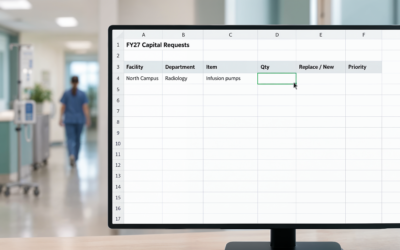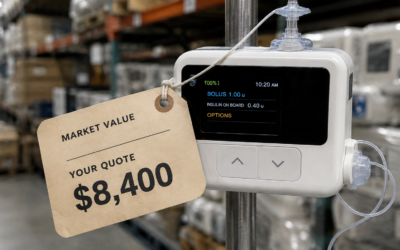

Every device bought outside the standard arrives with unquoted operational debt that clinical engineering absorbs for the next seven years.
A capital request gets approved on two things: a clinical need and a quoted price. The quote covers the box on the dock. It says nothing about the specialized test equipment a biomed needs to calibrate it, the spare parts you now stock for a decade, the one technician who slowly becomes the only person who can fix it, the interface IT has to keep alive, or the patch cycle cybersecurity inherits the day it joins the network. That work is real and it recurs. It just lands on people who were not in the room when the decision was made.
Clinical Engineering leaders have a flat phrase for this: a consequence of variation. Having a single standard platform (such as one pump type or model) in each hospital unit is the normal, manageable situation. The operational friction begins when the same clinical function requires four different equipment models across the health system, each carrying separate service contracts, specialized technician training, and independent supplier points of contact. The average hospital now runs 10 to 15 connected medical devices per bed, and a large system can carry well past 350,000 of them. Every redundant brand variant within that inventory introduces unique OEM software licenses, specific service certifications, and an independent supply chain to manage.
The further apart those offices sit, the more cost slips through the space between them, because the people who feel it had no standing at the moment of purchase.
THE ACCOUNTABILITY GAP
Authority and upkeep sit in different offices
That split is the whole problem. The authority to buy lives with clinicians, service-line leaders, and supply chain, who weigh the device on its merits and the number on the quote. The ongoing accountability for equipment uptime, system interoperability, and digital safety falls entirely onto clinical engineering, IT, and cybersecurity teams. The further apart those offices sit, the more cost slips through the space between them, because the people who feel it had no standing at the moment of purchase. The same 2025 analysis found asset tracking splintered among clinical engineering, IT, and information security, with devices frequently deployed or reconfigured without cybersecurity oversight. That is where the blind spots start.
While procurement teams execute a single transaction, the support ecosystem absorbs the operational lifecycle for the next decade. You can watch this happen with the most ordinary device in the building.
A WORKED EXAMPLE
Two pumps is never two pumps
Adding a secondary brand of smart infusion pump forces an entirely parallel operational track: managing dual drug libraries, duplicating clinical training protocols, and expecting floor nurses to differentiate conflicting device failure modes during a 2 A.M. shift.
2025 made that cost concrete. That year, Class I recalls, the FDA’s most serious classification, hit smart-pump lines from four different manufacturers: BD Alaris, Baxter Novum IQ, Baxter Spectrum, ICU Medical Plum Duo, and Fresenius Kabi Ivenix. Each additional pump platform multiplies logistical exposure because it requires distinct recall tracking and physical inventory isolation while forcing clinical education teams to execute separate retraining cycles. Operating four fragmented pump platforms turns a high recall year into four simultaneous fire drills that completely swamp the biomedical engineering shop.
The FDA’s own guidance for facilities says to stand up a multidisciplinary team, biomedical engineering included, to evaluate pumps before purchase and to standardize the drug library. The people who will carry the device are meant to be in the room when it gets chosen. Most of the time they are not.
The purchase quote captures only visible capital expense; the true fiscal impact is the unbudgeted operational overhead trailing behind it.
The purchase quote captures only visible capital expense; the true fiscal impact is the unbudgeted operational overhead trailing behind it.
THE INVISIBLE TAX
What the quote leaves out
Procurement teams prioritize immediate capital expenditure because that is the visible number on the contract. Downstream operational costs compound throughout the equipment lifecycle, routinely erasing any upfront savings achieved by purchasing an off-standard asset.
Upfront variance savings are systematically cannibalized by ongoing lifecycle maintenance costs.
Downstream departments inherit the permanent operational burden of off-standard assets without ever participating in the procurement decision.
THE RIPPLE
One device, four departments
The cost impacts the entire health system. A single non-standard platform radiates friction outward, forcing multiple departments to absorb unbudgeted labor hours. Cybersecurity teams face the steepest burden because medical devices are built to last 10 to 15 years while the software inside them is supported for 3 to 5, a mismatch laid out at an April 2025 congressional hearing on legacy medical devices. Claroty’s 2025 analysis of more than two million connected devices found that nearly every hospital it studied was running equipment with known, exploited vulnerabilities. That January, the FDA disclosed a hidden backdoor in a widely used patient monitor, one CISA found in every firmware version it analyzed. Every redundant platform a health system introduces adds another vulnerability vector for cybersecurity teams to continuously monitor and mitigate.
Downstream departments inherit the permanent operational burden of off-standard assets without ever participating in the procurement decision.
THE FIX
Give engineering a seat, and a ceiling
Mandating a single platform across an entire asset category represents over-standardization, an approach that eliminates supplier competition and restricts clinical choice within large healthcare networks. The strategic alternative requires establishing an intentional platform ceiling for each equipment category. Integrating Clinical Engineering directly into capital planning workflows allows value analysis committees to enforce these specific caps based on risk profile. The system establishes sole-source limits for low-complexity assets while capping life-critical equipment lines at a strict dual-source maximum. This structure transforms downstream inventory variation from an accidental operational burden into a strictly regulated procurement threshold.
An established formulary sets a strict platform ceiling for each asset class. Any variance request to exceed the cap demands formal justification prior to purchase order issuance.
Aggregate data from the OpenMarkets platform confirms this diversified sourcing reality across major healthcare networks. Platform metrics indicate that 42 percent of equipment categories utilize a sole-source model, while the remaining volume is distributed across dual-source and multi-source strategies. Operational requirements fluctuate by asset type, meaning health systems must establish an intentional platform ceiling for each category to prevent unmanaged vendor expansion.
BEFORE YOU ADD A PLATFORM
Before you add a platform, seven strategic questions
The objective of an equipment standard is to shift operational evaluation upstream, forcing analysis before capital allocation occurs.
1.) Can an asset already within our established standard meet this clinical requirement?
2.) What specific test equipment, OEM parts inventories, and specialized technical certifications will Clinical Engineering inherit?
3.) Who provides equipment service during off-shifts, and what is the mitigation plan for institutional knowledge loss when that technician departs?
4.) What software interfaces and configuration dependencies must IT maintain to support connectivity?
5.) How does this asset alter the cybersecurity attack surface, and which internal team owns risk mitigation?
6.) What is the total cost of ownership (TCO) across the asset lifecycle compared to the initial purchase quote?
7.) Is the clinical utility significant enough to justify the permanent operational burden?
WHERE THIS FITS
Make the second invoice visible before the first one is signed
The institutional accountability gap closes when equipment standards and technical stakeholders are integrated directly into the procurement process from the start. OpenMarkets Formulary embeds your organization’s approved medical device standards directly inside the active capital buying workflow. This ensures off-standard requests require formal justification prior to review, eliminating unmanaged inventory variance before assets reach the hospital loading dock.
An effective standard systemizes procurement integrity. It ensures every clinical exception is executed with full total cost of ownership visibility while capital allocation can still be adjusted.
SOURCES
- Asimily, The State of Cyber Asset Exposure Management in 2025.
- FDA, Class I Infusion Pump Recalls (2025).
- FDA, Infusion Pump Risk Reduction Strategies for Facility Administrators and Managers.
- Claroty, State of CPS Security: Healthcare Exposures 2025; FDA Safety Communication, Cybersecurity Vulnerabilities with Certain Patient Monitors from Contec and Epsimed (January 2025).
- OpenMarkets, aggregate sourcing mix across customer health systems.