
A field note on the administrative work that migrated into clinical hands, and how to find it in your own organization
I have asked a lot of nurse managers to walk me through how equipment actually gets requested at their hospital. Most of them open their inbox.
It is all one pile. A staffing question from the night shift sits above a rep following up on a quote he sent nine days ago. Under that, a voicemail transcript from a second rep, a spec sheet forwarded by a third, and a note from finance asking which line item this belongs to. The prices came in on different days in different formats, and the quote that expires first is somewhere in the thread.
Nobody assigned him that half of it. The quotes have to get somewhere, into the ERP or into the capital budget approval process, and he is the person the reps have been emailing.
The inbox is a symptom. The condition is that a significant amount of procurement administration in American health systems now runs on clinical labor, and almost none of it is measured, budgeted or named.
Worth saying who that covers, because the term does a lot of work in this piece. Clinicians here mean two groups. Bedside providers: the physicians, nurses and clinical staff at the point of care. And clinical leaders: the department heads and service line directors, some of them clinical by training, some of them not. All of them know how the equipment gets used, all of them work inside care areas, and all of them answer for clinical outcomes and patient safety. The administrative work lands on both, and the second group absorbs more of it than anyone counts.
Nobody decided this
There was no meeting where a health system resolved that its OR directors would run sourcing. The work migrated one reasonable exception at a time.
Supply chain is stretched, often badly. The clinicians know the products better than anyone else in the building, and they are the ones who will live with the choice. So the request gets forwarded to the person who knows the most about it. That is a defensible call on any single request. Make it two hundred times and forwarding stops being an exception. It becomes the process, and it never gets written down as one, which is why it never gets staffed.
The result is a job with no title. It has real hours, real deadlines and real consequences when it slips, and it sits on top of a full clinical workload.
We measured the burden we could see
The administrative work that got counted is the work with a payer on the other end of it.
The American Hospital Association put hospital spending on collecting payment for care already delivered at $43 billion in 2025. Prior authorization, denials, appeals, documentation requests. The American Medical Association’s 2025 survey of 1,000 physicians found prior authorization taking 13 hours a week of physician and staff time, running about 40 authorizations per physician per week, with 94% saying it feeds burnout.
Those numbers exist because somebody had a reason to produce them. There is a counterparty on the other side, a claim, a denial and a dollar figure, and an entire industry organized around fighting over it. Measurement follows the fight.
The nursing side has been measured too, less often and with less money behind it. McKinsey had 310 registered nurses account for a twelve-hour shift across 69 separate activities and found 54% going to direct patient care, 15% to documentation, and 6% to what the study called hunting and gathering.
None of that counts the afternoon a department chair spends chasing one equipment approval through four inboxes. That hour has no payer, no claim and no denial attached to it. It happens outside the EHR. Nothing logs it, no dashboard aggregates it, and no committee reviews it. Insurance burden had a counterparty, which is most of why it eventually got a name and a budget line. This burden lives in email, and it got absorbed.
The stakes on the equipment side went up while nobody was watching. Hospital supply costs rose 9.9% in 2025. In a Black Book survey fielded in February of that year, 94% of health care administrators said they would have to cut procurement volumes or delay equipment upgrades. Capital decisions are getting more expensive and more consequential at the same moment the process for making them is running on borrowed clinical time.
The four places it hides
When we sit with health systems and trace an equipment request from first ask to purchase order, the clinical time concentrates in four places. They are consistent enough across organizations that it is worth checking all four.
Pre-request research. Before anything formal exists, someone has to figure out what is even available. That means calls with reps, sales decks, spec sheets in four different formats, and a lot of unpaid education from vendors who have an interest in the outcome. This work is invisible because there is no ticket yet, no request number and nothing in a queue. It is often the largest block of the four.
The quote chase. Once a direction is set, someone emails three or four suppliers, waits, follows up, waits again, and gets back documents that cannot be compared without manual work. Different bundles, different accessory lists, different service terms, different expiration dates. A nurse manager or a biomed lead ends up building the comparison by hand because that is the only way one exists.
The approval chase. Capital requests move through department leadership, finance, sometimes IT and security, sometimes clinical engineering, and value analysis. Almost nowhere in that chain is there a visible owner and a visible status. So the requester becomes the tracking system. He sends the polite follow-up, finds out it has been sitting in the wrong inbox for eleven days, and re-sends it. Every week that adds is a week the department runs on the equipment it was trying to replace.
Re-entry and reconciliation. The quote arrives as a PDF. The purchasing system needs structured line items. Somebody retypes them. Later, the invoice does not match the PO because an accessory was bundled differently at the last minute, and somebody reconciles that too. This is where the errors get created and where they get discovered, usually by different people, weeks apart.
Add those four up for one moderately complex request and you are into double-digit hours. Now count how many requests your organization runs in a year.
Clinical participation and procurement administration are not the same job
The reason this persists is that both activities travel under one label.
Clinical participation is judgment. Which of these three products belongs in my rooms, given how each of them has failed on my unit over the last decade, what my staff can be trained on, and what the workflow around it actually looks like at 3 a.m. That expertise is scarce, it cannot be bought, and it is the reason capital decisions come out right when they do. It belongs in the process and should never leave it.
Procurement administration is movement. Gathering information, normalizing it, routing it, entering it, reconciling it. That work is essential to running a health system. It requires no clinical license.
Somewhere along the way the industry stopped distinguishing between the two. When a service line says it wants clinical involvement in equipment decisions, what it usually gets is a clinician doing procurement administration, and what it usually loses is the judgment it was trying to capture. The tooling has improved a great deal in the last five years, and nearly all of that improvement went to inventory. Barcodes, RFID, par levels, point-of-use capture, expiration tracking. Very little of it went to the request-to-PO path, which is where the clinical hours actually go. Across the health systems we work with, that path is still mostly email, and the people moving requests along it still mostly hold clinical licenses.
What it costs
Roughly three things, and the more expensive they get the harder they are to see.
The hours are the cheap part, and they are still not cheap. Every hour a perioperative director spends normalizing line items is an hour of scarce clinical leadership spent on data entry, at leadership rates, in an organization that is short of exactly that person.
The delay is worse. Every handoff in a manual chain creates a queue, and every queue creates a chance for the request to stall, expire or restart. Quotes go stale. Prices move. A capital cycle closes with the request still in it. The department keeps running the old unit for another year, and nobody logs that as a procurement outcome.
The judgment is the expensive one. When the Thursday afternoon disappears into reconciling vendor names, the director’s read on which pump belongs in his rooms either never gets formed or gets formed in the hallway on the way to the meeting. The committee decides off the comparison in front of it, which contains everything except the thing he knows. That trade shows up on no ledger anywhere in the organization.
There is a fourth cost that is harder to argue about because the data is not clean. People who came into this profession to treat patients spend a meaningful share of their week on procurement clerical work, and they notice. Whether that shows up in your retention numbers is difficult to isolate. It would be strange if it did not show up at all.
How to find out how far it has gone in your building
Do not commission a survey. Surveys about administrative burden return the answer the respondent thinks you want.
Ask three clinical leaders to forward you their sent folder from last week, unedited. Then count how many of those messages are about a product, a price, a quote, an approval status or a line item. You will have your answer before lunch, and it will be more honest than any instrument you could field.
If you want to go one level deeper, pick one equipment request that closed in the last quarter and reconstruct it end to end. Who touched it, in what order, how many days it sat between touches, and how many of the people who touched it hold a clinical license. Most organizations have never looked at a single request this way. The reconstruction usually takes an afternoon and it usually surprises the people who commissioned it.
Questions worth asking before you sign off on the process
- Where does a new equipment request enter the organization, and is there one place or eleven?
- Who owns a request between the moment it is submitted and the moment it is approved, and can the requester see that owner without sending an email?
- When three quotes arrive for the same clinical function, who normalizes them into a comparable format, and what is that person’s job title?
- How many times is the same information typed into a system in a single request, and by whom?
- What is the median number of days a request sits in each stage, and does anyone measure it?
- If a clinician disappeared from the process tomorrow, which steps would stop moving? Those are the steps quietly assigned to clinical staff.
- At what point in the process is clinical judgement actually asked for, and is it before or after the field has been narrowed?
That last one catches more organizations than the rest of the list combined. Clinical input arrives late, after the options have been filtered by whoever happened to gather them, and by then the judgment is being applied to someone else’s shortlist.
What the fixed version looks like
Clinicians should stay in equipment decisions. The argument here is about the shape of their involvement, so that what they contribute is the part only they can contribute.
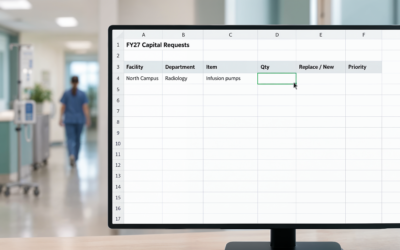
In practice that means a request enters through one intake rather than a set of inboxes. Quotes come back in a structure that makes a comparison an actual comparison rather than an exercise in matching vendor vocabulary. Approvals move along a defined path with a visible owner and a visible status at every step, so nobody has to become the tracking system. Line items reach the purchasing system without a human retyping them from a PDF. Capital planning across departments sits in one view rather than in a dozen spreadsheets that get reconciled in October.
That is the work we build at OpenMarkets. Formulary handles the catalog, request and quoting path. CapConnect organizes capital planning across departments. Optimizer brings market comparables to the decision so the judgment call is made against real market context. The point of all of it is narrow: keep clinical judgment in the decision and take the clerical work off the people making it.
Underneath the software, this is a boundary problem. The line between clinical work and administrative work eroded slowly, and erosion is quiet, and nobody ever sends an invoice for it. Redrawing that line takes a deliberate decision from someone senior enough to make it. It will not come from the director who is already behind on his Thursday.
Sources
American Hospital Association, “Costs of Caring 2026,” March 11, 2026. https://www.aha.org/costsofcaring
American Medical Association, “2025 AMA Prior Authorization Physician Survey,” 1,000 practicing physicians. https://www.ama-assn.org/system/files/prior-authorization-survey.pdf
McKinsey & Company, “Reimagining the nursing workload: Finding time to close the workforce gap,” May 26, 2023. Survey of 310 registered nurses across 69 shift activities.
Black Book Research, healthcare tariff impact survey, February 2025, as reported by HFMA.
OpenMarkets, aggregate observations across customer health systems.