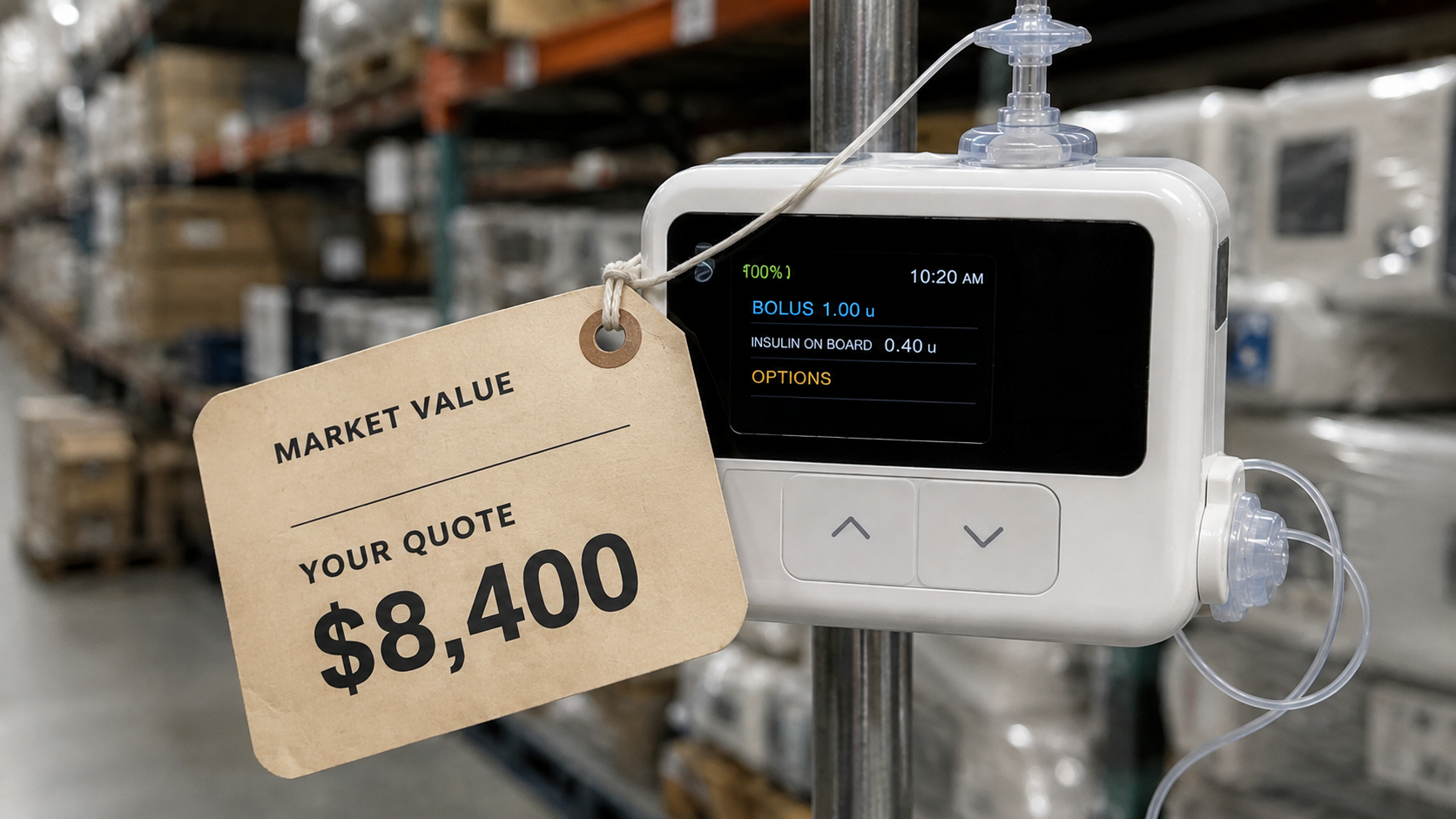
A buyer at St. Clair Health had a rented T-pump coming off lease and a buyout quote in hand. Before she signed, she sent the quote out for a market check instead of working it herself. It came back renegotiated. She approved the new number and signed. In her words: “With OpenMarkets, I was able to negotiate a buyout of our T-pump rental equipment for $2,100 less than the original quoted cost. Having the right procurement insights at the right time made all the difference.” Monica Chiaramonte • St. Clair Health.
Nearly every capital purchase in American healthcare is missing what she had. The money is approved and the authority is clear, and the person deciding still has no way to judge the number.
THE QUESTION
One number, with nothing behind it
Every purchase order starts with a question the buyer usually cannot answer: was that a good price? A quote is one supplier’s number for one buyer on one day. It says nothing about whether there is room in the number, what a refurbished or demo unit runs, or how far the supplier would move if someone asked. Finding that out is work, and it is not the buyer’s job.
THE PRESSURE
The market is repricing itself
Hospital supply spending rose 9.9 percent in 2025, and spending on surgical and medical instruments passed $10 billion (American Hospital Association, Costs of Caring, 2026). One driver sits behind much of it: 62 percent of the medical devices used in US hospitals are imported, and tariffs on them now run between 10 and 50 percent depending on the country of origin (UNC Center for the Business of Health, 2025).
Rising costs change what a quote is. A higher number might be a supplier passing through a real cost, or a supplier widening a margin while prices are moving anyway. Both look identical on the page. Telling them apart takes a market check: someone who works these prices every day, asking the supplier the question before the buyer signs.
“With OpenMarkets, I was able to negotiate a buyout of our T-pump rental equipment for $2,100 less than the original quoted cost. Having the right procurement insights at the right time made all the difference.”
Monica Chiaramonte • St. Clair Health
THE PATTERN
What checking the number is worth
Where the quote gets checked before it is signed, the savings show up at every scale. The rental buyout came in $2,100 under quote. One health system, in its first six months of running capital quotes through a market check, saved an average of $5,200 per purchase. A single seven-figure musculoskeletal order came in $27,500 under quote, about 2.5 percent of a $1.1 million buy.
Capital governance assumes the opposite distribution. Dollar thresholds decide which purchases get a committee, which get value analysis, which get a second look, on the theory that the risk sits where the invoices are biggest. The savings followed one variable: whether anyone checked the quote before signature. Purchase size did not predict them.
THE SECOND PROOF
The system behind the $5,200
That six-month average comes from a multi-hospital health system that recently rebuilt its capital process end to end, and the story behind the number starts somewhere other than price.
The old setup will sound familiar. Capital planning and approvals ran on installed desktop software. Changing a cost center, a vendor, an approver, or a requester meant a ticket to IT or an outside data team. The capital equipment manager fielded the same question week after week, where is my request, because finding an approval’s status took several steps in a system that occasional users never learned. Support was a help desk queue, with answers sometimes days out. At the far end of the process, purchase order data still had to be keyed into the ERP by hand and corrected when it did not match.
None of those frictions appears on an invoice, and every one of them costs money. A request that stalls in a queue waits, and when prices are moving, a quote that expires while it waits comes back higher.
The rebuild put planning, approvals, and purchasing in one place. Web-based, configured to the system’s own approval paths and spending thresholds, integrated with the ERP so requisitions and purchase orders move without re-keying, and administered by the capital team itself rather than through IT tickets. A requester can now see where a request stands without asking anyone. With the process visible, the team began sending its equipment and service-contract quotes out for a market check. That is where the $5,200 average came from.
THE GOVERNANCE GAP
Reviewed quarterly, spent daily
In an independent survey of 1,335 supply chain professionals across 1,019 provider organizations, 90 percent called supply chain a top-three non-labor financial lever, 81 percent said they cannot see the function in near-real time, and 83 percent said executive review happens less than quarterly (Black Book Research, 2026). The largest controllable cost in the building gets a quarterly look while the purchasing underneath it runs every day.
The pressure on that blind spot is rising. Among hospital executives running median equipment capital budgets of $15 million, 40 percent plan to cut or defer capital equipment purchases (TD Securities, 2025). Deferral means going without equipment. The savings above came out of purchases these systems were approving anyway.
THE MISSING TRANSPARENCY
The price no one legislated
Fifteen years of healthcare price-transparency rules all point at what the patient pays: the chargemaster, the negotiated rate, the surprise bill. Almost nothing points at what the hospital pays its suppliers. That number moves without any regulation at all. It moves when someone checks the market before the buyer signs.
FIVE QUESTIONS
Worth asking before the next purchase
- When a quote lands, who checks it before it is signed, and is that person named anywhere in the process?
- On your last five capital purchases, was any quote renegotiated? By whom, and by how much?
- Which purchases get a market check, and is that line drawn by dollar size or by where money actually leaks?
- Can a requester find out where their request is without emailing anyone?
- What does a stalled request cost when the re-quote comes back higher than the original?
WHERE THIS FITS
Take the quote off the desk
Another approval layer would slow the small purchases down and hide them further. The fix is a market check the buyer does not have to run herself. OpenMarkets Optimizer takes the quote off her desk, checks it against the market, negotiates with the supplier on her behalf, and returns the number inside 48 hours. She sees the result before she accepts it, and the decision stays hers. Her pricing stays hers as well; nothing about one hospital’s quote is shared with another. The same platform keeps planning, approvals, and purchasing in one place, so the second question, where is my request, has an answer too.
Confidence changes decisions. Better decisions change markets. The place to start is the next quote that lands.
SOURCES
- Monica Chiaramonte, St. Clair Health, customer account (used with the hospital’s approval).
- OpenMarkets customer health systems: a rental buyout, a first-six-months capital savings average, and a single-order example. The six-month figures come from one system’s capital program, shared without attribution at the customer’s request.
- UNC Kenan-Flagler Center for the Business of Health, analysis of medical device tariffs and import dependence, 2025.
- American Hospital Association, Costs of Caring, 2026.
- Black Book Research, 2026 State of Healthcare Supply Chain, survey of 1,335 supply chain professionals across 1,019 provider organizations.
- TD Securities, Checkup on Hospital Capital Spending and Macro Risks, 2025.