Last month we found out why.
We spent close to three hours in a room with the people who run capital equipment at a large IDN, mapping their process from the first sign of a need to the purchase order. They run it well. Their approval tool has been in place for years, their buyers catch things most systems miss, and every one of the 5,600-plus capital purchase orders they placed last year was checked by hand before it went out. What the system could not show them was the plan.
THE TWO PROCESSES
One runs in the system. The other runs in spreadsheets
Walk through the process as the system sees it and it looks complete. A request is created. It routes to approvers. Someone checks the quote to see whether it has expired or been swapped for a different one between approvals. A purchase order goes out. Every step of that half is visible.
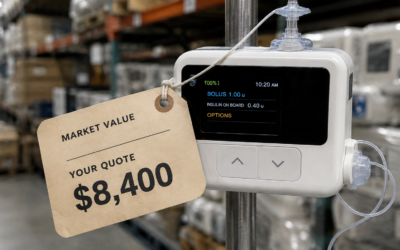
Walk it as a facility CFO sees it and the first half is missing. Each one keeps a list of what the facility will need next year and prioritizes it locally. A need enters the system only after the facility has decided to buy it, and by then someone has usually already gone to a supplier, so the request arrives with a quote attached, often a PDF with a few days left before it expires.
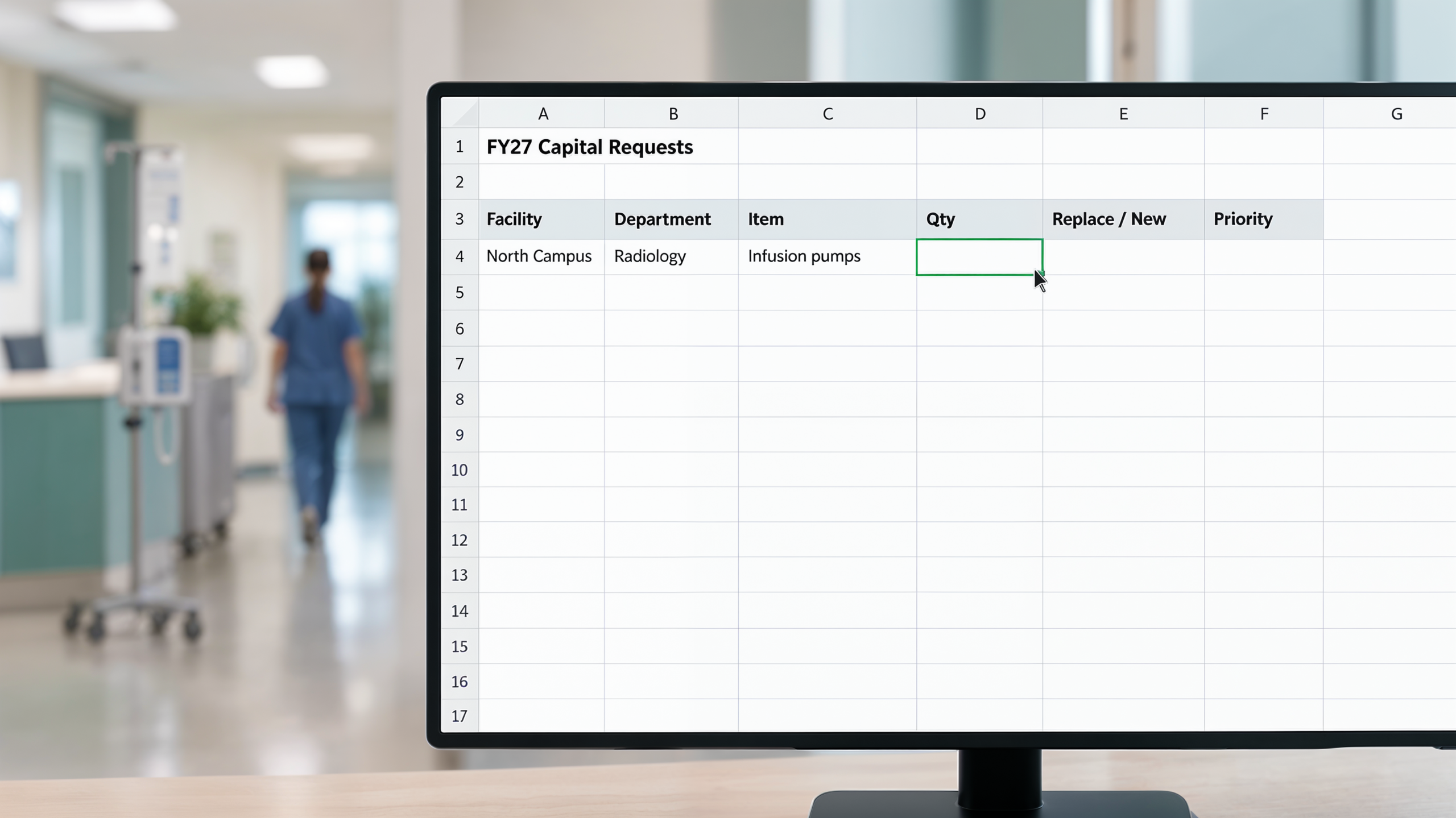
That list is the capital plan. It is the only document in the building that says what a facility will need next year and the year after, and the people who could aggregate that demand across facilities, or match it to equipment sitting idle somewhere else in the system, cannot open it.
THE SPREADSHEET
Why the plan stays where it is
The IDN has tried. Two or three times since 2022 the planning lead pushed the markets to enter their lists in the system earlier in the year. None of the pushes held, and the reason becomes clear once you see the form. Creating a project record in the system takes 40 to 50 fields. Adding a line to the spreadsheet takes a minute, and nothing happens to a market that skips the system until it is ready to buy.
So the spreadsheet is doing a job. It is where a facility keeps its needs safe while it waits for its turn. HFMA’s capital planning guidance from this summer describes the same dynamic from the finance side: “In many health enterprises, advocates of specific unmet capital needs that squeak loudest get the grease.” A facility gains nothing by showing its list early, and a facility that shows up in November with a quote in hand and three days on the clock gets a decision.
THE COST
What the room said it costs
We asked what all of this costs them, and the answers came from the people who live with it.
The clinical engineering VP told us she had sold a piece of equipment this year and then watched a request for the identical item come through from another facility two weeks later. Neither facility could see the other’s list.
The supply chain lead described announcing a new group buy and getting zero takers the first year, because the group buys looked nothing like the needs facilities had actually budgeted for. HealthTrust’s group-buy sourcing lead, Eric Brauer, put the same problem in one sentence in July: “One of the biggest challenges is timing.” A group buy has to be announced while the plan is still open, and at this IDN the plan is open only inside a spreadsheet.
Then we asked the room what they thought they were leaving on the table by buying one quote at a time instead of aggregating. The number they landed on was 8 to 10 percent.
That is on 5,600 purchase orders a year. It also explains the hand-checking. When every purchase arrives as its own quote, every quote has to be inspected, and the quotes are not clean: HealthTrust’s Jared Dougherty, who runs medical capital equipment sourcing there, says “we often see a 20% to 30% error rate on quotes that come through the system.”
By the time a request reaches approval, the decision about what to buy has largely already been made.
THE PATTERN
Every health system has an approval process
This IDN is not unusual. Black Book surveyed 1,335 supply chain professionals across 1,019 provider organizations this spring, and 81 percent said they lack near-real-time visibility across their critical supply domains. Every one of those organizations has an approval process. The approval process is where demand finally becomes visible, and by then the only question left is whether to say yes.
The price of saying yes is rising. Vizient forecast medical supply costs up 2.41 percent for 2026, and by August supply chain leaders were telling Becker’s Hospital Review that technology-enabled products, which is most of what comes through a capital process, were running above that. That is the equipment being bought one quote at a time.
THE QUESTION
Next year and the year after
By approval, the useful question has already been answered. The question that saves money is what the whole system is going to need next year and the year after, and at this IDN that gets decided facility by facility, in spreadsheets, months before the enterprise sees any of it.
FIVE QUESTIONS
For a capital planning committee to put to its markets before the next cycle
- Where does each market’s list of next year’s needs live today, and who outside that market can open it?
- How many fields does it take to put a need into the system before a quote exists, and what does a market get in return for doing it early?
- On the last group buy, how many facilities had already budgeted for something that did not match it?
- In the last twelve months, how many times did one facility buy an item another facility had just sold or retired?
- What share of last year’s capital purchase orders arrived with a quote that had to be corrected or re-quoted before approval?
WHERE THIS FITS
The plan and the request in one place
Asking markets to fill in 40 fields earlier did not work at this IDN, because it asked each facility to work against its own interest. The plan moves into the system when the system is the easier place to keep it. OpenMarkets CapConnect holds the capital plan and the request in the same place, so a need is visible to the enterprise from the day a facility writes it down, and the request that follows carries the plan with it. Demand that is visible early can be aggregated, matched to surplus at another facility, or lined up with a group buy while there is still time to join one.
Next year’s needs are already written down somewhere in every market. The work is making them visible to the people who can do something about them before the quote arrives.
SOURCES
- OpenMarkets working session with a large integrated delivery network, August 2026. Shared without attribution at the organization’s request.
- HFMA, “Health system capital planning is not for the faint of heart,” Peter Chadwick, Brian Fisher and Jeff Goldsmith, July 30, 2026.
- HealthTrust, The Source, “Smarter Capital Equipment Planning for Health Systems,” July 21, 2026.
- Black Book Research, “2026 State of Healthcare Supply Chain IT,” April 16, 2026.
- Becker’s Hospital Review, “Where hospital supply costs are outpacing forecasts,” Aug 21, 2026, citing Vizient’s 2026 supply cost forecast.